Search
For years, AI readiness was largely a data problem. Organizations invested heavily in governance, metadata, data quality and modern platforms to ensure information was accurate, secure and accessible. If the data was clean and available, most organizations considered themselves prepared for whatever AI capabilities emerged next.
Agentic AI challenges that assumption. As AI moves beyond answering questions and begins influencing decisions or initiating actions, the conversation shifts from data availability to business understanding. Organizations must ensure that AI understands not only the data itself, but also the context, relationships and rules that govern how the business operates.
This is where ontology enters the picture. In our context, an ontology is a system for organizing information about a business that allows its AI agents to share a vocabulary amid data-driven decision-making. More importantly, it identifies a company’s goals, relationships and customer behavior patterns to better drive decisions.
The Behavior Behind the Data
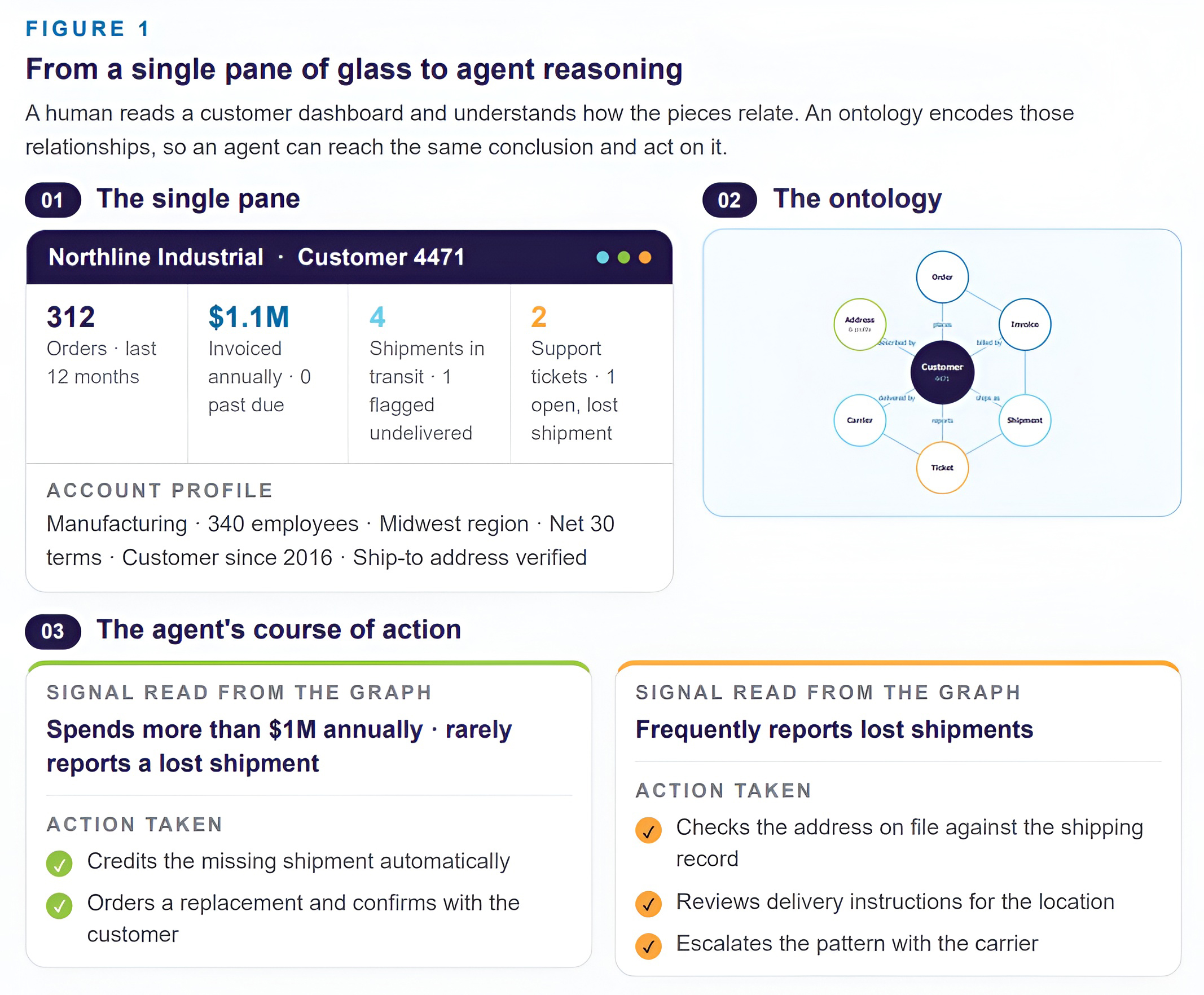
Consider a scenario where a human pulls up a customer dashboard. The dashboard provides a “single pane” view of all customer data and interactions — orders, invoices, shipment tracking, support tickets, demographic data and more. A human understands how those elements relate to one another and uses that context to determine the best course of action. With an ontology, an agent could replicate that reasoning.
For example, it could recognize that a customer spends more than $1.1M annually but rarely reports lost shipments. Similar to a human, the agent might automatically credit the missing shipment and order a replacement. On the other hand, if a customer frequently reports lost shipments, the agent could check address information, review delivery instructions and potentially escalate the issue with the carrier.
Once those relationships are defined, the agent can trace how it reached a decision, explain its reasoning and operate within clearly defined boundaries. The difference may seem subtle, but it is significant: data tells a system what exists, while ontology helps it understand what those things mean.
The Context of Customer Actions
Many organizations have started building ontologies without ever using the term. Customer intelligence is a good example.
Information exists across sales conversations, pursuit activities, stakeholder meetings, project documentation, financial systems, delivery records and support interactions. Most organizations have access to this information, but much of it remains disconnected. A stakeholder mentioned during an early pursuit may later influence a purchasing decision. A project’s outcome may create a future opportunity. A financial trend may explain why a customer’s priorities have shifted. Each data point has value on its own, but its true significance comes from how it relates to everything around it.
This is where the idea of a customer ontology becomes powerful. By connecting customer conversations, stakeholder relationships, project history, opportunities, strategic initiatives and financial information into a shared data model, organizations create a foundation that allows AI to identify patterns and provide context rather than simply retrieve information.
The questions also begin to change. Instead of asking what happened during the last customer meeting, leaders can explore which priorities have consistently surfaced over time, which stakeholders have the greatest influence on key decisions or where successful delivery outcomes may create opportunities for future engagement. Those answers require more than search. They require an understanding of relationships and context.
Focus on Meaning, Not New Models
Much of the discussion around enterprise AI still centers on models, but long-term success may depend more on whether organizations can clearly define the concepts, relationships and business rules that shape their operations. The organizations creating the most value with AI are unlikely to be those that simply deploy the newest models first. More often, they will be the organizations that have invested in understanding their business well enough to provide AI with the context it needs to reason effectively.
Clean data will always matter, but as AI becomes more involved in decision-making and execution, the ability to capture meaning, relationships and context may prove even more important. That is ultimately what ontology provides, and why it is becoming a critical component of genuine AI readiness.
Talk with us about where an ontology would give your AI the context it needs. Connect with us today at ai@eimagine.com.