Search
A Socio-Technical Approach for Sustainable Enterprise Impact
How we help organizations navigate the people, process, and technology dimensions of AI — and what we’ve learned from doing it.
Executive Summary
Artificial intelligence (AI) projects have proliferated across large organizations, but in our experience, sustainable value remains elusive without a holistic approach that goes beyond technology. Most of the organizations we work with are eager to unlock AI’s potential across their functions — from HR and customer service to operations and engineering — yet their progress often stalls in what we call “pilot purgatory.” Studies show that while 88% of companies now report using AI in at least one business process, only about 23% have actually scaled those capabilities enterprise-wide. We see this pattern consistently: the gap between a successful pilot and enterprise-scale impact is rarely a technology problem. It stems from organizational and human factors that must be addressed through an integrated approach.
At eimagine, we believe the key to long-term AI success lies in a socio-technical approach that concurrently addresses people, process, and technology. This mindset starts from a simple premise: building an AI model or deploying a new tool is often the easy part. The real challenge — and the real reward — is aligning that technology with how people actually work, how processes operate, and how decisions are governed. An AI system that isn’t embraced and integrated by the organization will not generate sustainable value, no matter how sophisticated the underlying capability.
This white paper reflects our approach to AI transformation and how we help clients translate AI ambitions into lasting results. It is grounded in our direct delivery experience across enterprise and public-sector engagements — including large-scale ecosystem orchestration, organizational change management, and AI operationalization. These real-world engagements illustrate the principles we describe throughout: that lasting AI impact comes from aligning technology with the people who use it and the processes that govern it.
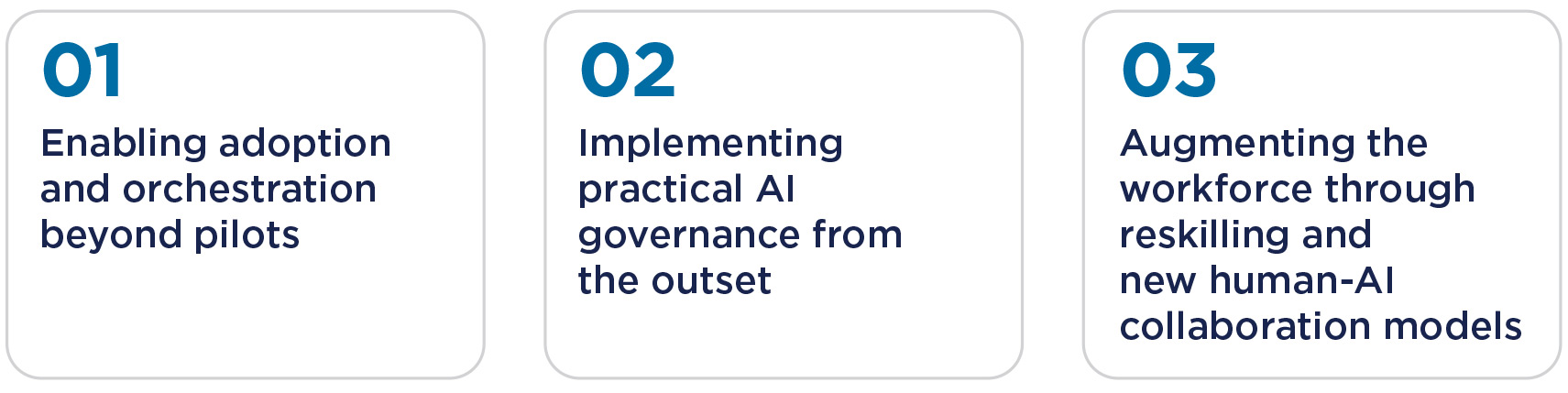
Three cross-cutting themes have emerged from our work as critical success factors:
Our Socio-Technical Philosophy for AI Transformation
In our work with enterprise clients, we consistently see that the organizations making the most meaningful progress with AI are those who treat it as a socio-technical challenge — not purely a technical one. That means treating people, processes, and technology as inseparable and equally important elements of success. The reason is straightforward: the main obstacles to AI impact are seldom algorithmic. They are organizational. Poor adoption, misaligned processes, and unclear governance can cause even a technically sound AI solution to stagnate. Aligning AI with how people work and how decisions get made is what actually drives lasting value.
Together, these reinforce one another in a virtuous cycle. Adoption and orchestration ensure that AI becomes part of “how work gets done” at scale. Practical governance builds trust and removes roadblocks. Workforce augmentation empowers employees to leverage AI as a force multiplier rather than a threat — which further accelerates adoption and impact.
What Sets Our Approach Apart
Adoption Over Hype
We focus on business adoption and value realization — not technological novelty. That means identifying real problems, delivering tangible quick wins, and keeping the focus on outcomes and user needs rather than chasing the latest capability. In practice, enhancing an existing process with targeted AI assistance will almost always outperform a flashy use case that has no clear owner or workflow.
Integration of People, Process, and Technology
We don’t introduce technical capabilities in isolation. Every AI solution we deliver comes paired with process alignment and change management — because the most common failure mode we see isn’t a bad model, it’s a good model that nobody uses because it doesn’t fit how work actually gets done.
Bridging Business and IT
One of the most consistent contributions we make is acting as an interpreter between business units and technical teams. We translate a strategic challenge into a well-scoped technical problem — and then translate outputs back into actionable insights that business leaders can act on. This bridge-building is where a lot of AI value either gets created or gets lost.
Embedded Partnership Model
We work side-by-side with our clients’ own teams rather than operating at arm’s length. Solutions are co-created so that internal teams feel genuine ownership. This embedded approach produces more durable results than traditional consulting delivery models, and it accelerates trust — which is foundational when you’re asking an organization to change how it works.
Contextual and Pragmatic
We invest time in understanding the specific culture, systems, and constraints of each organization we work with. Wherever possible, we build on the tools and infrastructure a client already has rather than pushing net-new platforms. This pragmatism speeds time to value, lowers risk, and resonates strongly with stakeholders who are protective of prior technology investments.
Focus on Sustainable Capacity
We measure our success by whether a client can continue their AI journey without us. That means coaching team members throughout the engagement, producing thorough documentation, and setting up processes that are designed for long-term maintenance. Our goal is never consultant dependency — it is equipping our clients’ own people to own, sustain, and expand what we’ve built together.
People, Process and Technology
Our socio-technical approach addresses three complementary dimensions simultaneously. Technical capability alone is insufficient without the process structures to embed it and the organizational readiness to sustain it.
| People (Organization & Culture) | Process (Workflows & Governance) | Technology (Tools & Data) |
|---|---|---|
| Business & domain experts engaged early | Map AI to key workflows & pain points | Leverage existing data and IT infrastructure |
| Cross-functional translation (HR, IT, etc.) | End-to-end project delivery (pilot to prod) | Rapid prototyping of AI/ML models |
| Change management & user training integrated | Hybrid team: partner + internal staff | Scalable data pipelines & architecture |
| Embedded, on-site collaboration | Governance & ethical guidelines built-in | Secure, compliant deployment |
| Knowledge transfer & internal upskilling | Continuous improvement processes | Integration with enterprise systems |
From Opportunity to Impact: Our Phased Engagement Approach
In our experience, turning an AI opportunity into sustainable impact is a journey — one that moves from initial curiosity and strategic exploration through piloting, scaling, and continuous improvement. We’ve learned that a partnership-oriented approach is what maintains continuity across those phases, keeping focus on long-term objectives while securing meaningful wins at each step.
Each phase builds on the last, blending technical development with organizational change. Our socio-technical mindset permeates every stage: even in early exploration, we’re already asking questions about governance and user adoption. During piloting, the focus on quick wins is balanced with ensuring the solution fits actual workflows. By the time we move toward scaling, employee training and governance mechanisms are already underway.
One principle we return to consistently is the value of showing rather than telling. Early in our discovery conversations, we often bring lightweight prototypes or visual demos — a working mock-up of an AI assistant, for example — to ground abstract discussions in something tangible. This helps stakeholders visualize a realistic end state and makes it far easier to refine use cases and build buy-in. Long requirement documents rarely accomplish what a well-timed prototype can.
Pragmatism guides every decision we make about technology. We work to deliver value quickly by leveraging what a client already has — their cloud platforms, their data infrastructure, their existing tooling — rather than defaulting to net-new technology. Those early wins build the credibility and organizational momentum needed to justify investing further in more ambitious initiatives.
Ultimately, we define success in terms of business impact, not just delivery milestones. A successful pilot for us isn’t just a functional model — it’s one that demonstrates meaningful, acknowledged improvements: faster cycle times, better decision quality, measurably reduced burden on staff. With that kind of tangible success established, the case for scaling becomes self-evident.
Driving Adoption & Orchestration Beyond Pilots
The first critical theme in achieving enterprise AI success is closing the chasm between promising pilots and broad adoption. We see this challenge frequently: an organization has proven that AI can work within a sandbox or a single department, but struggles to embed those solutions enterprise-wide. An advanced team builds a powerful model, or an innovative function introduces an AI tool — yet a year later, the impact remains limited to a small corner of the organization.
Why Do So Many AI Initiatives Stall After the Pilot Stage?
From our delivery experience, we’ve seen several patterns emerge as consistent culprits:
Fragmented Ownership & Strategy
Different business units or functions launch their own AI projects in isolation. Without a unifying strategy or leadership alignment, these efforts remain siloed — sometimes competing for the same resources or producing conflicting approaches. We help organizations overcome this by establishing cross-functional governance structures and ensuring each pilot connects to a broader roadmap.
Insufficient Change Management
In our experience, lack of user adoption is the number one barrier to AI integration — not technical failure. A pilot led by a small, motivated team often doesn’t naturally scale because the broader workforce was never engaged or trained. Without structured change management, employees either resist the new tool or simply don’t know how to incorporate it into their routines.
Data & Process Silos
Pilots are typically built on a controlled slice of data and a simplified version of a process. Scaling requires integrating disparate data sources across regions or business units, and adapting to process variations that weren’t visible in the pilot environment. We work with clients to anticipate and address these integration challenges before they halt momentum.
Unclear Value Proposition
If the benefits of a pilot weren’t clearly measured and communicated, it becomes very difficult to secure the investment and enthusiasm needed for scaling. We consistently link pilots to explicit KPIs and strategic goals so that the results speak for themselves when it’s time to make the case for expansion.
How We Approach Orchestration
Orchestration is our answer to these barriers — actively connecting and managing the multiple elements of an AI rollout so they reinforce rather than undermine each other. In practice, this means helping clients:
Establish an AI steering committee or center of excellence that spans IT, HR, and business units. This body ensures that disparate efforts align to a common vision, shares lessons learned across pilots, and keeps leadership engaged and informed.
Develop a knowledge-sharing framework so that a successful pilot in one function becomes a replicable model for others — including templates, playbooks, and communities of practice that keep practitioners connected.
Build a change network of champions across the organization — early adopters who can advocate for AI, provide peer support, and surface adoption friction in real time. In our experience, peer influence is far more powerful than top-down mandates when it comes to changing how people work.
Driving organization-wide adoption requires both top-down and bottom-up effort, and we play a role in both. Executive sponsorship and a clear AI strategy provide direction and resources. Grassroots engagement — helping individuals and teams see how AI makes their work easier — fuels the day-to-day momentum. We often serve as the connective tissue between those two layers: facilitating communication across stakeholders, aligning project-level work to enterprise strategy, and surfacing adoption blockers before they become roadblocks.
From Our Experience — Operational Orchestration
Aligning Fragmented Systems Through Process-First AI Enablement
In our work within large public-sector health ecosystems composed of a dozen or more independently managed systems, we consistently find that coordination challenges — not a lack of algorithms — are the primary constraint on value.
We introduced a process-first, AI-enabled operating model focused on orchestration and workforce effectiveness rather than system replacement.
We defined structured SOP frameworks across disparate systems, creating consistent escalation paths and repeatable processes where none had previously existed.
Our solution included Copilot-style AI interface directly into employee workflows — guiding staff through cross-system processes step by step, reducing cognitive load and improving execution consistency.
We maintained human-in-the-loop design throughout: AI reduced complexity, but every citizen-impacting decision remained with a human.
This results in faster cross-system issue resolution, reduced dependency on vendor-held institutional knowledge, and a scalable foundation for future AI-enabled operations.
Practical AI Governance: Building Trust and Managing Risk
The second critical theme is practical AI governance — establishing the policies, guardrails, and oversight mechanisms needed to manage AI’s risks and build the trust that adoption depends on.
As AI moves from experimentation into core operations, it surfaces questions that organizations can’t afford to leave unanswered: How do we prevent biased decisions? How do we protect data privacy and comply with applicable regulations? Who is accountable when something goes wrong? In our experience, the absence of clear answers to these questions is one of the most consistent sources of institutional hesitation — and a primary reason why promising AI initiatives stall at the executive level.
How We Think About Governance
We approach governance not as a compliance exercise, but as an enabler of adoption. A well-designed governance framework gives leaders the confidence to say yes, and gives employees the assurance that the tools they’re being asked to use are safe, fair, and accountable.
Data Privacy & Security
We design privacy protection into AI solutions from day one — not as an afterthought. This means enforcing data handling policies from the outset, building in anonymization and access controls, and ensuring that data usage aligns with both regulatory requirements and internal standards. The organizations that run into trouble are almost always the ones that treat this as a post-deployment concern.
Ethics & Bias Mitigation
AI can inadvertently perpetuate bias — particularly in workforce-facing or HR applications. We build in regular auditing of AI outputs for fairness, require diverse and representative training data, and set up human-in-the-loop processes for high-impact decisions. These steps reassure both leadership and employees that the AI is being used responsibly.
Transparent Decision-Making
Trust deepens significantly when people understand why an AI tool is surfacing a particular recommendation. We advocate for explainability as a design requirement, not an optional feature. When employees can see the reasoning behind an output, adoption rates increase and override decisions become more informed.
Clear Roles & Accountability
One of the first questions we help clients answer is: who owns this AI system once it’s deployed? We work to clearly define roles — model owner, data steward, decision approver — so that accountability is never ambiguous. Clear ownership is what ensures someone is watching performance, addressing issues, and maintaining compliance over time.
Risk Management Embedded in Process
We apply a “governance by design” approach that bakes risk checks into each phase of development rather than treating them as a gate at the end. When risk management is integral to the work rather than a separate review, organizations move faster and more confidently — because concerns are identified and addressed before they become problems.
From Our Experience — AI Readiness & Governance Foundation
Building the Foundation Before Scaling: Governance-First AI Operationalization
In our work with growing industrial organizations, we often encounter a common pattern: leadership recognizes AI’s potential, but the underlying environment — content structure, permissions, process consistency — isn’t ready to support responsible deployment.
We delivered a structured AI readiness and operationalization model, beginning with facilitated use case discovery to identify and prioritize high-value opportunities aligned to real business outcomes.
Before any AI deployment began, we ran a parallel workstream focused entirely on governance readiness — restructuring SharePoint and Teams content, reviewing permissions, establishing metadata standards, and eliminating outdated or duplicate information.
We then developed and piloted an AI Contract Review Assistant as a visible, business-aligned quick win — demonstrating that responsible AI deployment and operational value are not in tension.
We also helped leadership think through automation versus hiring decisions with clarity, grounded in actual AI capability rather than speculation.
Result: the organization transitioned from AI exploration to an actionable execution roadmap, with governance and readiness established for enterprise-scale adoption.
In practice, we help clients stand up AI oversight structures — whether that’s a formal committee, designated ownership within an existing leadership team, or a practical AI Code of Conduct that sets clear expectations for acceptable use. The specific form matters less than the intent: giving the organization a shared framework for making decisions about AI, and the confidence to keep moving. Governance done right is not an impediment to progress. It is what makes progress sustainable.
Empowering the Workforce: Augmentation, Reskilling & Culture
The third theme — and in our view, often the most decisive in the long run — is the evolution of the workforce alongside AI. Technology changes rapidly, but organizations change only as fast as their people do. No matter how well-designed the model or well-structured the governance, AI will underdeliver if the people expected to use it aren’t equipped, engaged, and genuinely supported through the change.
How We Approach Workforce Enablement
Skills Development & Training
We invest in building genuine AI fluency across the organizations we work with — from executive-level strategy literacy to hands-on capability for frontline teams. AI literacy programs demystify the technology, reduce resistance, and build the confidence employees need to actually use these tools in their day-to-day work. About 42% of global CEOs are now focused on upskilling for the AI era, with nearly as many actively rethinking job roles — a reflection of how central the workforce dimension has become.
User-Friendly Design & Trust
We design for the humans who will actually use these tools, not just for technical elegance. That means intuitive interfaces, clear and interpretable outputs, and — wherever possible — visibility into how the AI arrived at its recommendation. We consistently build in human-in-the-loop mechanisms: AI that suggests, advises, or surfaces — with a human confirming. That structure builds trust faster than any training program.
AI as Augmentation (Not Automation Alone)
One of the most important conversations we have with clients is about framing. The organizations that achieve the highest adoption are those that position AI as something that makes employees better at their jobs — taking over the routine and repetitive so that people can focus on the work that requires human judgment and strategic thinking. That framing is not just communication strategy; it shapes how solutions get designed.
Role Redefinition and Career Pathways
We help organizations think ahead about workforce evolution — mapping the new roles and capabilities that AI will create or elevate, and building transition paths for employees whose current roles will shift. When organizations approach this proactively and transparently, what might otherwise feel like a threat becomes a genuine opportunity for career development and growth.
Adoption & Change Management
Ultimately, embedding AI into an organization is as much a cultural challenge as a technical one. We bring structured change management into every engagement — clear communication from leadership, active involvement of employees in solution design, and deliberate recognition of early adoption wins. Those elements, consistently applied, are what shift an organization from AI skepticism to AI confidence.
From Our Experience — Enterprise Change Management at Scale
Scaling Adoption Across a Global Organization Through OCM Enablement
In our work with large global organizations running multiple concurrent transformation programs, we’ve seen that adoption challenges — not technical limitations — become the dominant risk when change management is inconsistent or overly centralized.
We delivered a hands-on OCM enablement and execution model — combining strategy, tooling, and coaching rather than advisory-only engagement.
We developed structured change management plans across multiple concurrent initiatives, including impact assessments, mitigation strategies, and communications and training frameworks.
We supported a proof of concept for an OCM software platform that enabled teams to self-manage change: creating and tracking plans, monitoring adoption progress, and reporting across projects.
We extended OCM coaching across change specialists, non-change specialists, and project contractors alike — distributing capability rather than concentrating it.
We facilitated governance workshops to improve execution alignment and leadership visibility into transformation progress.
Result: standardized OCM execution across multiple initiatives, reduced bottlenecks tied to limited specialist capacity, and a scalable, repeatable change management capability that outlasted the engagement.
The interplay between workforce enablement and the earlier themes of adoption and governance is something we observe in every engagement. When employees are well-trained and trust the tools, adoption follows. When they see that governance is in place ensuring the tools are safe and fair, that trust deepens. And when adoption is broad, the organization generates more real-world feedback, which in turn strengthens governance and refines the tools. Investing in people isn’t the “soft” part of an AI program — it is the mechanism that makes everything else compound.
Partnership: The Foundation of Long-Term AI Success
Underpinning everything we’ve described is a fundamental belief about what kind of relationship produces durable AI transformation. Complex, human-centered change is most successful when approached as a genuine partnership — not a vendor transaction. In a partnership model, we are not delivering a service and stepping back. We are working alongside our clients’ teams toward a shared definition of success, with shared accountability for reaching it.
What Partnership Looks Like in Practice
Shared Goals and Co-ownership
We align explicitly with our clients on what success means — whether that’s improving operational efficiency, enhancing employee experience, or enabling a specific business outcome — and we treat ourselves as accountable for those outcomes, not just for completing a scope of work. That shared ownership typically translates into joint KPIs and regular steering conversations that keep both sides honest.
Knowledge Transfer and Capability Building
We prioritize making our clients smarter and more capable throughout every engagement. We pair our practitioners with our clients’ internal teams, document our work thoroughly, and build in deliberate knowledge transfer at every phase. The measure of a successful engagement for us is whether the organization can maintain, extend, and build on what we’ve created together — without us in the room.
Transparency and Trust
We are candid about what is and isn’t working — including when something we’ve built isn’t performing as expected. That kind of transparency builds the trust that allows for faster iteration and more honest problem-solving. It is especially important when AI projects touch sensitive areas like workforce roles, data, or organizational structure, where ambiguity erodes confidence quickly.
Deep Contextual Understanding
We invest real time in understanding each organization’s history, culture, and operating realities before we recommend anything. A solution that worked well for one client may need significant adaptation for another — and we’ve learned that the best way to discover what will actually work is to listen carefully, spend time with the people doing the work, and resist the impulse to fit a client’s problem to a pre-packaged answer.
Flexibility and Long-Term Support
We stay available as our clients’ needs evolve. That might mean scaling support as an AI program grows, providing oversight while internal teams build confidence, or re-engaging for periodic strategy check-ins as the technology landscape shifts. Our teams are deliberately multi-disciplinary, which means we can bring the right expertise to bear as priorities change — whether that’s technical depth, change management, or governance.
In essence, our partnership model is designed to enable our clients’ long-term independence with AI — not to create ongoing dependency on us. By working together through the full arc of an AI engagement — strategy alignment, solution co-creation, adoption, governance, and workforce enablement — we help clients build a foundation that compounds over time. The value of the relationship grows as the organization’s own AI capability grows.
Conclusion – From Experimentation to Transformation
For many enterprises, AI has transitioned from a strategic aspiration to an operational imperative — yet delivering on that promise demands more than technical capability. In our experience, it requires a comprehensive approach that addresses the full complexity of organizational life: the ways people work, the processes that drive operations, and the guardrails that ensure safety and trust. Technology alone, no matter how advanced, cannot overcome silos, inertia, or cultural resistance.
The engagements we’ve described throughout this paper reflect what this looks like in practice — from orchestrating fragmented systems in a large government health ecosystem, to scaling change management across a global life sciences organization, to building AI governance foundations for a growing industrial firm. In each case, our work began not with technology selection but with understanding people, processes, and what the organization was actually ready to absorb.
From what we’ve seen, adoption, governance, and workforce enablement are the critical triad of factors determining whether AI remains a collection of interesting experiments or becomes a genuine force for competitive advantage. When organizations orchestrate these elements effectively:
Promising pilots evolve into ubiquitous capabilities that boost efficiency, quality, and innovation enterprise-wide.
Risks are managed without suffocating progress, because governance is embedded early and designed to enable rather than restrict.
Employees become AI-empowered, using these tools to be more strategic and creative rather than feeling threatened by automation.
Our socio-technical approach is how we help organizations navigate this journey. It means investing as much in change management, training, and governance as in data pipelines and algorithms. It requires patience and cultural change, but it produces results that are resilient and scalable — not just impressive in a demo.
AI transformation is a marathon, not a sprint, and it is best run with a partner who has done it before. With the right partnership in place — one grounded in co-ownership, knowledge transfer, and honest alignment between technology and business reality — an organization can move decisively from AI experimentation to AI transformation. The reward is a durable competitive advantage: AI embedded in the organization’s DNA, continuously delivering value and opening new possibilities in the years to come.