Search
AI has moved rapidly from an emerging technology to a boardroom priority. Investment is accelerating, use cases are multiplying, and executives are under increasing pressure to demonstrate measurable results. But activity should never be confused with progress. Organizations can launch pilots, deploy new tools, and encourage experimentation without creating meaningful business impact. The difference lies in whether AI is treated as a technology initiative or as an enterprise capability tied to measurable outcomes, accountable leadership, and a clear plan for scale. Over the past year, I have observed a consistent pattern across organizations of all sizes. Teams become excited about the possibilities of AI. Departments begin experimenting with new tools. Leadership sees early signs of promise. Yet many organizations struggle to move beyond isolated successes and achieve enterprise-wide value.
The challenge is rarely the technology itself. More often, organizations underestimate the level of business transformation required to realize meaningful results. Technology can be deployed quickly. Changing processes, behaviors, decision-making, and operating models takes significantly more effort. The organizations generating the greatest return from AI understand this distinction. They view AI not as a software deployment project, but as an operational and organizational transformation initiative. In fact, while eimagine is a technology consulting company, we are increasingly finding ourselves spending more time helping clients navigate the organizational change associated with AI adoption than implementing the technology itself. Ironically, the technology has often been the easy part. The harder challenge is helping organizations rethink how work gets done, how decisions are made, and how people and technology collaborate moving forward.
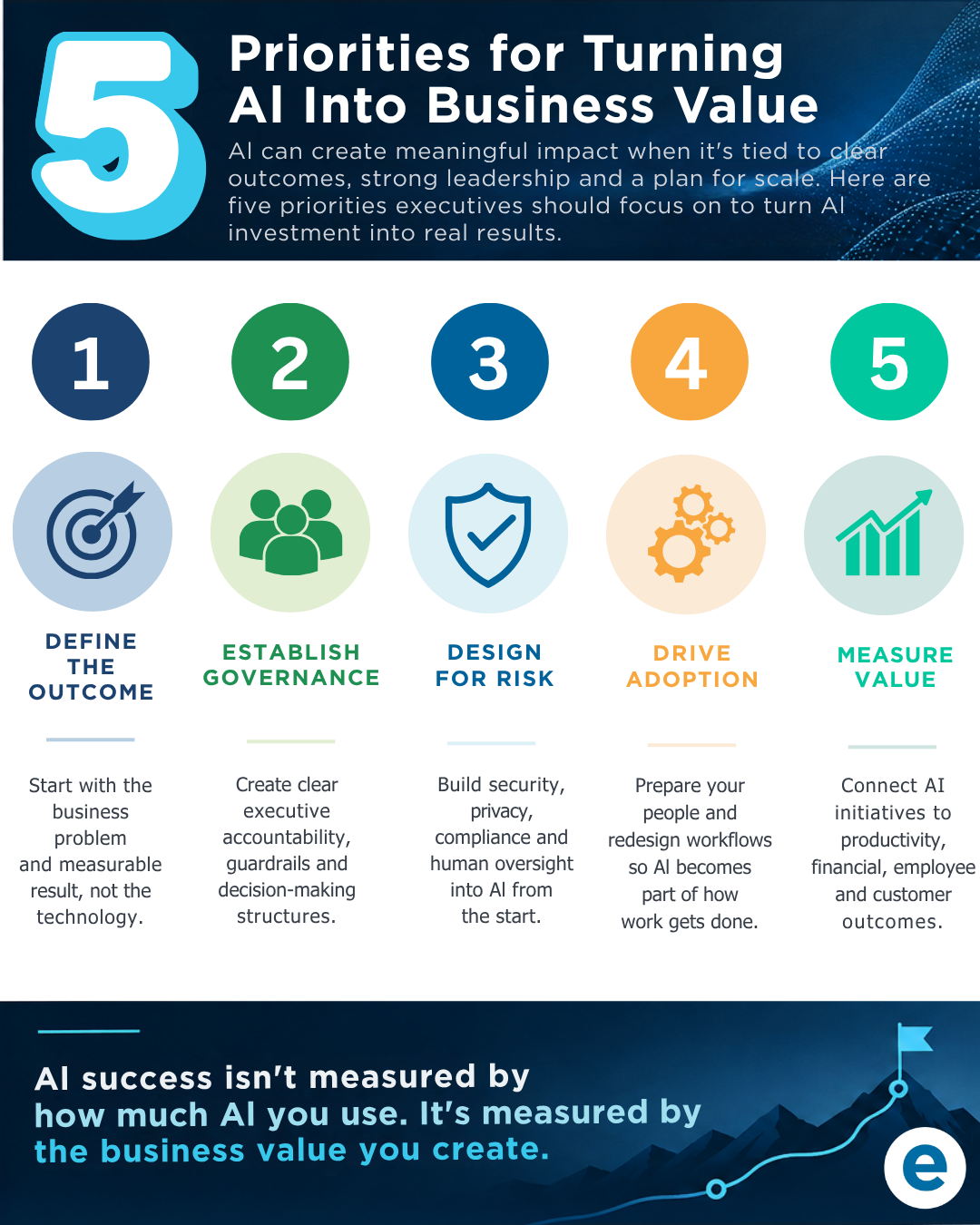
For executives leading an AI transformation, five priorities consistently rise to the top.
1. Define the Outcome Before Choosing the Technology
The strongest AI strategies begin with a business problem, not a platform. Too many organizations start by evaluating tools and then searching for opportunities to apply them. The result is often a collection of disconnected pilots that generate activity but fail to improve business performance. The more effective approach is to work backward from the desired outcome. Leadership should identify where AI can materially improve the performance of the business. In some cases, that means reducing operating costs through automation. In others, it means increasing employee productivity, accelerating service delivery, improving customer experiences, strengthening decision-making, or creating competitive advantage. The key is selecting outcomes that matter to the business, not simply outcomes that demonstrate technical capability.
Executives should be able to answer several fundamental questions:
- What business problem are we solving?
- Which performance metric should improve?
- How will success be measured?
- What level of improvement justifies the investment?
- Who owns the outcome?
This may sound straightforward, but it is one of the most common gaps in AI initiatives today. Organizations can often describe the technology they are implementing in remarkable detail while struggling to explain the measurable business value they expect to create. Successful AI programs reverse that equation. Technology should support the strategy. The strategy should never be built around the technology.
2. Make Governance an Executive Responsibility
AI governance cannot be delegated solely to IT, legal, compliance, or security teams. While those functions play critical roles, the decisions associated with AI adoption involve broader questions about risk, accountability, customer experience, workforce impact, investment priorities, and business strategy. Those are leadership decisions. One of the most significant mistakes organizations make is waiting until AI initiatives have scaled before establishing governance structures. By that point, different teams may have adopted different tools, created inconsistent policies, and established competing standards regarding data usage and oversight.
Good governance creates alignment before those challenges emerge. At its core, governance should answer questions such as:
- Who approves new AI use cases?
- What data can and cannot be used?
- What level of human oversight is required?
- How are risks evaluated?
- Who is accountable when outcomes fall short?
The objective is not to create bureaucracy. It is to create clarity. Organizations with strong governance frameworks often move faster than their peers because employees understand the rules, leaders understand the risks, and decisions can be made confidently rather than being delayed by uncertainty. Governance should not slow innovation. It should provide the foundation that allows innovation to scale responsibly.
3. Treat Security and Risk as Design Requirements
Security and risk management are not barriers to AI adoption. They are prerequisites for scale. AI fundamentally changes how information is created, accessed, analyzed, and shared. As a result, organizations must think differently about cybersecurity, privacy, intellectual property, regulatory compliance, and the reliability of AI-generated outputs. These considerations become increasingly important as AI moves closer to mission-critical business processes. An inaccurate summary may create an inconvenience. An inaccurate recommendation related to healthcare, finance, customer communications, public services, or business operations can create far more significant consequences. That is why security, legal, compliance, and risk leaders should be involved at the beginning of AI initiatives rather than at the end.
Every use case should be evaluated through the lens of:
- Data sensitivity
- Potential business impact
- Regulatory and contractual obligations
- Human oversight requirements
- Reputational risk
The organizations scaling AI successfully are not avoiding risk altogether. They are identifying, understanding, and managing risk intentionally. The greater the potential impact of an AI-driven decision, the stronger the controls should be.
4. Build Adoption Into the Business Case
This is where many AI initiatives ultimately succeed or fail. Technology alone does not create value. People create value by using technology to improve how work gets done. Yet adoption is frequently treated as the final phase of implementation rather than a core component of the business case. Employees need more than access to AI tools. They need clarity regarding when AI should be used, how outputs should be validated, where human judgment is required, and how success will be measured. Managers need to reinforce new behaviors. Existing processes often need to be redesigned. Most importantly, organizations must recognize that AI literacy is becoming a foundational business capability. The organizations that outperform their peers will not necessarily have access to better models. They will have employees who are better equipped to integrate AI into daily decision-making, customer interactions, and operational workflows. That represents both a technology challenge and a leadership challenge. Adoption should never be measured solely by licenses issued or users logged in. It should be measured by changes in productivity, customer outcomes, decision quality, employee effectiveness, and business performance.
5. Establish Clear AI Goals and Measure Value Relentlessly
Every successful transformation initiative starts with a goal. Organizations routinely establish targets for revenue growth, profitability, customer satisfaction, employee engagement, and operational performance. AI should be no different. Leadership teams should define what success looks like and establish measurable objectives for their AI transformation efforts. Without a clearly articulated target, it becomes difficult to determine whether the organization is truly realizing value or simply experimenting with new technology.
I recently spoke with the CEO of an organization who publicly challenged his leadership team to achieve a minimum 25% productivity improvement through the adoption of AI. The target created focus, urgency, and accountability across the business. Rather than treating AI as a side project, each functional area was asked to identify opportunities to improve efficiency, eliminate manual work, enhance decision-making, and accelerate outcomes. The result was not only broad adoption of AI capabilities, but measurable business improvement that ultimately exceeded the original goal across the organization’s core functions. Whether the target is 10%, 25%, or 50%, the principle remains the same. What gets measured gets managed. Far too many AI projects continue to be measured by activity metrics. Prompt volume is not value creation. User logins are not value creation. Pilot programs are not value creation. Value creation occurs when measurable business outcomes improve. Executives should establish scorecards that connect AI initiatives directly to operational, financial, employee, and customer metrics. Those scorecards should be reviewed regularly and used to determine which initiatives deserve additional investment, which require refinement, and which should be discontinued. Not every AI use case will succeed. That is perfectly acceptable. What matters is creating an environment where investments are evaluated objectively, and decisions are driven by evidence rather than enthusiasm. Organizations that consistently measure outcomes will learn faster, scale faster, and ultimately derive more value from their investments.
The Leadership Imperative
The most important question for executives is not whether their organization is using AI. It is whether AI is making the organization more effective. Answering that question requires more than technology decisions. It requires leadership decisions. Leaders must determine where to invest, what outcomes matter, how risk will be managed, who is accountable, and how the organization must evolve to work differently. The framework is straightforward:
- Define measurable business outcomes.
- Establish clear governance and accountability.
- Embed security and risk management from the start.
- Drive adoption through workforce readiness and workflow integration.
- Establish AI transformation goals and measure business value relentlessly.
Organizations that follow this discipline move beyond experimentation and create a repeatable model for realizing value from AI investments.
Those that do not may generate significant activity without producing meaningful results.
Ultimately, AI adoption is not a technology strategy. It is an operating model imperative. The organizations that recognize that early will be best positioned to scale with purpose, manage risk effectively, and transform AI investments into sustained business performance.